
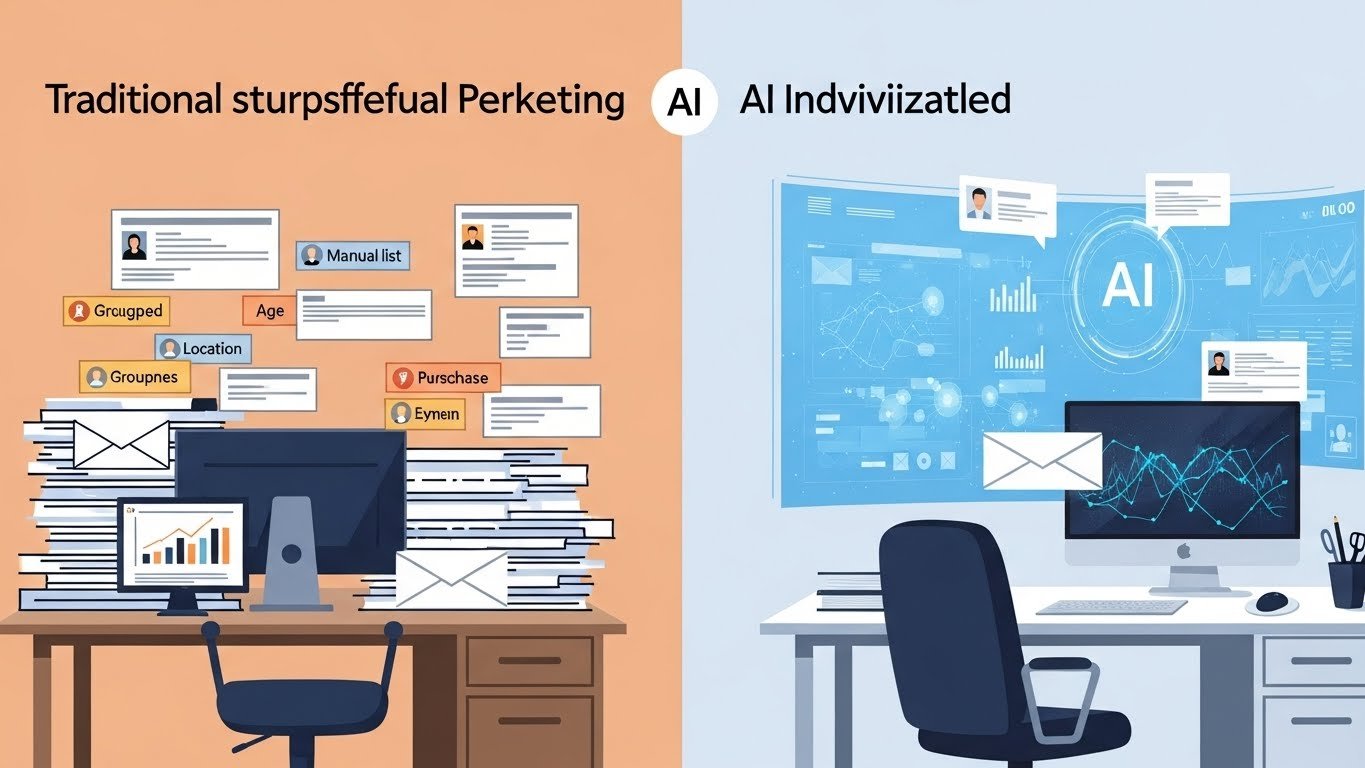
I still remember the moment email marketing changed for me. It was 2019, and I was staring at a campaign report for an e-commerce client that defied everything I thought I knew. We’d split their list—half received our carefully crafted, manually segmented campaign, and half went through a new AI-powered system we were testing.
The AI-driven segment outperformed us by 47% on conversions.
Not open rates. Actual purchases.
What stung wasn’t just losing to software. It was realizing how much we’d been leaving on the table with traditional approaches. We’d been doing “personalization” by inserting first names and segmenting by broad demographics. The AI was doing something fundamentally different—learning individual behavioral patterns and responding to signals we couldn’t even see, let alone act on manually.
That experience launched what’s become a five-year deep dive into AI-powered email marketing. I’ve implemented these systems for startups, mid-market companies, and enterprise brands across retail, SaaS, financial services, and publishing. Some implementations have been transformative. Others have been expensive disappointments.
What follows is my honest attempt to explain what AI actually does for email personalization, which applications deliver real value, and how to implement these capabilities without losing the human judgment that great marketing still requires.
The Personalization Problem Email Marketing Has Always Had
Let’s be honest about traditional email personalization—most of it was pretty superficial.
We’d segment lists by purchase history, maybe browse behavior if we were sophisticated. We’d insert dynamic fields for names, locations, and past purchases. We’d create a handful of customer personas and craft messages for each.
This was better than nothing. Addressing someone by name outperforms “Dear Valued Customer.” Sending product recommendations based on purchase history beats random assortments. Basic segmentation matters.
But the limitations were severe. With traditional approaches, you could realistically manage maybe five to ten distinct segments before complexity became unmanageable. Each additional segment meant more content variants, more testing, more coordination. Most marketing teams simply couldn’t sustain that level of personalization at scale.
More fundamentally, manual segmentation treats people as members of categories rather than individuals. A 35-year-old woman who bought running shoes once gets the same messages as every other person in that demographic slice, regardless of whether she’s a marathon enthusiast who checks email at 5 AM or a casual jogger who’s most engaged on weekend afternoons.
The personalization ceiling wasn’t conceptual—we knew more individualized messaging would work better. It was operational. There simply weren’t enough hours in the day or team members to create truly individualized experiences for lists of any significant size.
AI broke through that ceiling.
What AI Actually Does Differently
Before diving into specific applications, I want to explain what’s fundamentally different about AI-powered email personalization, because the distinction matters.
Traditional email marketing operates on rules created by humans. If customer purchased X, send them Y. If subscriber hasn’t opened in 30 days, send reactivation campaign Z. These rules are explicit, created in advance, and applied uniformly.
AI-powered personalization operates on patterns learned from data. The system observes that Customer A tends to open emails on Tuesday mornings, respond to discount messaging, and purchase within a narrow product category. Customer B opens on Thursday evenings, responds to new product announcements, and explores widely. Without anyone writing explicit rules, the system begins treating these customers differently.
This pattern recognition operates at scales and speeds impossible for human analysts. An AI system can simultaneously track hundreds of behavioral signals—not just opens and clicks, but scroll depth, time spent, links hovered over, products viewed after clicking, purchase timing, return behavior, support interactions, and more. It can identify correlations and predictive patterns across millions of customers that no human analysis would uncover.
The result is what marketers call “segment of one” personalization—treating each subscriber as their own segment, with messaging tailored to their individual patterns rather than the patterns of a demographic slice they happen to fall into.
This isn’t magic, and it’s not perfect. AI systems learn from data, so they require sufficient historical information to make useful predictions. They can identify correlations but not causation. They optimize for metrics you specify, which may not always align with broader business goals. We’ll get into limitations later.
But when implemented thoughtfully, AI personalization delivers results that traditional approaches simply cannot match.
Send Time Optimization: The Low-Hanging Fruit
If you’re going to start anywhere with AI email personalization, send time optimization offers the most straightforward value.
The concept is simple: instead of sending campaigns to your entire list at the same time, AI determines the optimal send time for each individual subscriber based on their historical engagement patterns.
Traditional approach: Marketing decides the campaign goes out at 10 AM Tuesday because that’s when average open rates are highest.
AI approach: The system sends to Sarah at 7:15 AM because that’s when she typically opens emails. It sends to Michael at 8:42 PM because his engagement peaks in the evening. Same campaign, different delivery times, optimized for individual behavior.
The improvements are consistent and measurable. Across clients I’ve worked with, send time optimization typically lifts open rates 15-25% with essentially zero additional effort after initial setup. One retail client saw a 31% improvement in open rates just from implementing send time optimization, with no changes to content, subject lines, or anything else.
What makes this particularly valuable is the compounding effect. Higher open rates mean more opportunities for clicks. More clicks mean more conversions. More conversions mean more behavioral data to refine future personalization. The improvement feeds itself.
Most major email platforms now offer some version of send time optimization. Mailchimp, Klaviyo, HubSpot, Salesforce Marketing Cloud, and others have built these capabilities into their systems. Implementation is usually straightforward—enable the feature, allow sufficient learning time, and monitor results.
The limitation: send time optimization requires historical data. New subscribers without engagement history get sent at default times until patterns emerge. And for time-sensitive campaigns—flash sales, breaking news, event reminders—you may need to override optimization for urgency.
Subject Line Optimization: Where AI Gets Creative
Subject lines matter enormously—they largely determine whether emails get opened at all. Traditional optimization meant A/B testing a handful of variants, reviewing results, and gradually developing intuition about what worked for your audience.
AI transforms this process in two ways.
First, predictive scoring. AI systems can evaluate potential subject lines before sending and predict likely performance based on patterns learned from your historical data and broader email behavior. Rather than testing five variants to find the winner, you can evaluate dozens of options instantly and test only the most promising candidates.
Second, automated generation. Some platforms can generate subject line variations optimized for different segments or objectives. You provide the core message; AI creates variants tuned for urgency, curiosity, personalization, or whatever approach historically performs best for each subscriber segment.
I worked with a B2B software company that had resigned themselves to 18-22% open rates as their ceiling. Subject lines were competent but unremarkable. We implemented AI subject line optimization that personalized tone and framing based on each recipient’s historical response patterns.
Some subscribers received subject lines emphasizing data and specifics. Others received lines emphasizing outcomes and benefits. Same underlying message, different framing. Within three months, their average open rates climbed to 29%, with some segments exceeding 35%.
The creative tension here is worth acknowledging. Some marketers resist AI subject line assistance because writing subject lines feels like core creative work. I understand that instinct. But I’ve come to view AI as a collaborator rather than replacement—it can generate options and predict performance, but human judgment still decides what aligns with brand voice and strategic messaging.
Content Personalization: Beyond the First Name
Inserting subscriber names was the original email personalization. AI takes content personalization far beyond that simple substitution.
Dynamic Product Recommendations
The most commercially impactful application I’ve seen is AI-powered product recommendations embedded in emails. Rather than showcasing best-sellers or manually curated selections, emails display products predicted to appeal to each individual based on their behavior.
An outdoor gear retailer I worked with replaced their “featured products” email section with AI recommendations. The algorithm considered purchase history, browsing behavior, wishlist items, seasonal patterns, and inventory levels. Open rates stayed similar, but click-through rates increased 83%, and revenue per email nearly doubled.
The recommendations felt relevant because they were relevant. Customers who’d been browsing tents saw camping gear. Customers who’d purchased running shoes saw performance apparel. Customers who’d shown interest in premium items saw quality-tier recommendations. Each email felt curated for its recipient because, in a meaningful sense, it was.
Content Block Optimization
Beyond product recommendations, AI can personalize entire content blocks—which articles to feature in a newsletter, which testimonials to display, which calls-to-action to emphasize.
A financial services client runs weekly newsletters with educational content. AI personalization determines which three articles each subscriber sees based on their historical engagement with different topics. An investor focused on retirement planning sees different content than one focused on tax optimization, without anyone manually creating those segments.
Copy Adaptation
More sophisticated systems can adjust copy itself—not generating entirely new content, but selecting between pre-written variants based on predicted resonance. Short punchy copy for subscribers who engage quickly; longer detailed copy for those who prefer depth. Emotional appeals for some; logical arguments for others.
This requires creating more content variants upfront, but the investment often pays off. A SaaS company I advised created three copy variants for their onboarding sequence—concise, detailed, and conversational. AI routed new users to the variant predicted to resonate based on their signup behavior and early engagement patterns. Trial-to-paid conversion improved 23%.
Segmentation That Thinks for Itself
Traditional segmentation requires marketers to define segment criteria. Customers who purchased in the last 30 days. Subscribers who’ve clicked at least three times. Users in enterprise tier.
AI-powered segmentation inverts this process. Instead of defining segments and finding matching subscribers, AI identifies natural clusters based on behavioral patterns and predicts which messaging approaches will work best for each cluster.
Predictive Segmentation
The system might identify that certain subscribers cluster together based on engagement patterns—not demographics you’d have considered, but behavioral similarities you wouldn’t have spotted. Maybe there’s a segment that engages heavily with educational content but never with promotional content. Another that responds to urgency messaging but ignores value-focused appeals. Another that purchases repeatedly during seasonal sales but not otherwise.
These discovered segments often outperform human-designed segmentation because they’re based on actual behavior rather than assumptions about what should matter.
Lifecycle Stage Prediction
AI can predict where subscribers are in their customer lifecycle—not based on time since purchase, but based on behavioral signals suggesting engagement, consideration, or churn risk.
A subscription service client used AI to identify customers showing early churn signals—subtle changes in engagement patterns that preceded cancellation. Rather than waiting for explicit churn indicators (missed payment, cancellation request), they could intervene with retention messaging when customers were at risk but hadn’t yet decided to leave. Churn reduction was significant enough to meaningfully impact annual revenue.
Intent Prediction
Similarly, AI can identify purchase intent signals—browsing behavior, email engagement patterns, return visits—that predict imminent conversion. Subscribers showing high purchase intent can receive more aggressive promotional messaging; those not yet in buying mode can receive nurturing content.
This prevents the common problem of sending discount offers to people who would have purchased anyway at full price, while ensuring deal-sensitive buyers receive the incentives that might tip their decision.
Automated Journeys That Learn and Adapt
Email automation—triggered sequences responding to subscriber behavior—has been standard practice for years. AI transforms these automated journeys from static sequences to adaptive experiences.
Traditional Automation
A typical abandoned cart sequence might work like this: If cart abandoned, wait 2 hours, send reminder. If no purchase, wait 24 hours, send second reminder with discount. If still no purchase, wait 48 hours, send final reminder.
Everyone who abandons a cart receives the same sequence, same timing, same messaging.
AI-Enhanced Automation
An AI-powered approach adapts every element based on individual behavior:
Timing: Some customers respond to immediate reminders; others need time to consider. AI determines optimal delay for each individual.
Message content: Some customers need a simple reminder; others need objection handling. AI selects messaging based on predicted barriers.
Incentives: Some customers convert without discounts; others require incentives. AI determines whether to offer discounts and at what level, balancing conversion against margin.
Sequence length: Some customers decide quickly; others need multiple touches. AI determines how many messages each person receives before stopping.
The result is that two customers abandoning identical carts might receive entirely different sequences—different timing, different messaging, different incentives—because their predicted response patterns differ.
I’ve seen AI-optimized cart recovery sequences improve conversion rates 40-60% over static sequences, largely by reducing friction for quick converters and providing appropriate persuasion for hesitant ones.
Predictive Analytics: Knowing What’s Coming
Beyond optimizing individual campaigns, AI provides predictive intelligence that shapes broader email strategy.
Customer Lifetime Value Prediction
AI can predict likely customer lifetime value based on early behavior patterns. This allows differential treatment—investing more in nurturing high-value prospects while appropriately managing resources for lower-value segments.
A subscription business I worked with discovered that certain signup behaviors strongly predicted long-term retention. Users who engaged with onboarding emails in specific patterns were 3x more likely to remain subscribers after one year. This allowed prioritized attention on high-potential customers and early intervention for those showing concerning patterns.
Churn Prediction
Similarly, AI can identify churn risk before it manifests in explicit signals. Changes in engagement patterns, decreasing purchase frequency, reduced email interaction—these subtle signals can predict churn weeks or months before it happens.
Early identification enables intervention. A well-timed email to an at-risk customer—perhaps featuring their favorite products, highlighting unused benefits, or simply checking in—can redirect the trajectory before the customer mentally disengages.
Purchase Timing Prediction
For businesses with repeat purchase patterns, AI can predict when customers are likely to reorder. A consumable products company knows customers typically reorder protein powder every 6-8 weeks. But some customers order every 4 weeks; others every 12. AI learns individual patterns and triggers reminders at optimal times for each customer.
This prevents both premature messaging (annoying customers who aren’t ready to reorder) and late messaging (missing the window when customers start considering alternatives).
Real Implementation: What It Actually Takes
Theory is nice. Implementation is where things get real. Having rolled out AI email personalization at various scales, I’ll share what the process actually looks like.
Data Requirements
AI systems learn from data. Without sufficient historical data, predictions are unreliable. Before implementing AI personalization, assess what you have:
Email engagement data: Opens, clicks, conversions, timing. Most email platforms retain this automatically.
Behavioral data: Website browsing, product views, search history, cart behavior. This often requires connecting email systems with web analytics or e-commerce platforms.
Transaction data: Purchase history, order values, product categories, return behavior. Usually available from e-commerce or CRM systems.
Customer attributes: Demographics, account type, subscription tier. Wherever you store customer information.
The more data available, the more personalization is possible. But start with what you have—even basic engagement data enables send time optimization and some content personalization.
Platform Considerations
AI email personalization capabilities vary enormously across platforms.
Native capabilities: Most major email platforms now include some AI features—Mailchimp, Klaviyo, HubSpot, Salesforce Marketing Cloud, Adobe Campaign. These integrated features are usually easiest to implement, though they may be less sophisticated than specialized tools.
Specialized add-ons: Platforms like Optimail, Phrasee, Persado, and others specialize in specific AI applications—subject lines, send time optimization, content personalization. These often deliver superior performance in their specialty area but require integration work.
Custom development: Large enterprises sometimes build proprietary AI systems tailored to their specific data and needs. This offers maximum control but requires substantial data science resources.
For most organizations, starting with native platform capabilities makes sense. These provide meaningful improvement with minimal implementation friction. Specialized tools become worthwhile when you’ve extracted value from basic capabilities and want to push further.
Implementation Phases
I typically recommend a phased approach:
Phase 1: Foundation (Weeks 1-4)
- Audit existing data and integration capabilities
- Enable basic AI features in current platform (send time optimization, basic recommendations)
- Establish baseline metrics for comparison
Phase 2: Expansion (Weeks 5-12)
- Implement more sophisticated personalization (subject lines, content blocks)
- Connect additional data sources to improve predictions
- Develop variant content for AI optimization
Phase 3: Optimization (Ongoing)
- Refine models based on performance data
- Expand personalization to additional campaigns and journeys
- Consider specialized tools for highest-impact applications
Rushing implementation usually backfires. AI systems need time to learn, and teams need time to adjust workflows and develop appropriate content variants.
Team Implications
AI personalization changes what marketing teams actually do day-to-day.
Less time on: Manual segmentation, individual campaign optimization, repetitive A/B testing, send time decisions.
More time on: Creating content variants, monitoring AI performance, interpreting results, strategic planning, creative development.
The shift isn’t necessarily headcount reduction—though that’s sometimes the outcome—but role evolution. Marketers become more strategic and creative, less operational and tactical. This transition can be uncomfortable for team members whose value came from operational expertise.
Successful implementations typically involve team training not just on the tools, but on evolving roles and expectations.
Where AI Personalization Falls Short
Enthusiasm for AI capabilities shouldn’t obscure real limitations. Honest assessment helps avoid disappointing implementations.
Cold Start Problem
AI needs data to make predictions. New subscribers, new products, and new markets lack the historical information AI requires. Until patterns emerge, personalization defaults to generic approaches.
Strategies to mitigate: collect preference data during signup, use lookalike modeling to infer patterns from similar users, and implement progressive personalization that improves as data accumulates.
Optimization for Wrong Metrics
AI optimizes for the metrics you specify. If you optimize for open rates, AI will learn what gets opens—even if that’s sensational subject lines that disappoint on click-through. If you optimize for clicks, AI might learn to send excessive emails to your most engaged subscribers, risking fatigue.
The solution is thoughtful metric selection. Revenue per subscriber often works better than opens or clicks. Engagement over time beats immediate response. But even then, AI can’t account for brand perception, long-term relationships, or strategic considerations outside its measurement scope.
Data Bias Perpetuation
AI learns from historical data, including any biases embedded in that data. If past marketing underserved certain segments, AI might perpetuate that underservice. If certain messaging historically worked, AI will favor that messaging even if audience preferences are evolving.
Regular auditing—examining whether AI treatment varies appropriately across segments, whether emerging preferences are being captured, whether any groups are systematically disadvantaged—helps identify bias issues.
Explainability Challenges
When AI makes personalization decisions, explaining why can be difficult. Why did this subscriber receive this subject line? Why was this send time selected? Complex models don’t always yield clear explanations.
This creates practical challenges: customer service can’t explain why someone received specific messaging; stakeholders may distrust recommendations they don’t understand; debugging problems becomes harder.
Some platforms provide explanation features that surface reasoning behind decisions. Even without explicit explanations, monitoring aggregate patterns helps identify when AI behavior diverges from expectations.
Creativity Limitations
AI can optimize within defined parameters but can’t originate genuinely new creative directions. It can select between content variants you create but can’t create breakthrough messaging. It can identify what’s worked before but can’t predict what might work differently.
The most successful implementations maintain space for human creative experimentation alongside AI optimization. Use AI for refinement and scaling; reserve human creativity for innovation and strategic direction.
Privacy and Ethical Considerations
AI personalization depends on data, and data collection raises legitimate privacy and ethical concerns that responsible marketers must address.
Transparency
Subscribers should understand, at least generally, that their behavior influences what emails they receive. This doesn’t require technical explanations of AI systems, but preference centers that allow subscribers to influence personalization—choosing topics of interest, indicating communication preferences—both improve personalization quality and demonstrate respect for subscriber autonomy.
Data Protection
Behavioral data used for personalization falls under privacy regulations like GDPR and CCPA. Ensure data collection, storage, and use comply with applicable requirements. This includes appropriate consent mechanisms, data retention policies, and honoring opt-out requests.
Working with legal and compliance teams before implementing AI personalization prevents problems that are much harder to fix after deployment.
Manipulation Concerns
AI optimized to maximize conversions can learn manipulative techniques—exploiting urgency biases, leveraging loss aversion, targeting vulnerable moments. The line between persuasion and manipulation isn’t always clear.
I’ve seen AI systems learn that sending promotional emails during late-night hours increased conversions for certain segments—probably because tired, stressed people made more impulsive decisions. That’s not personalization that serves customers, even if it boosts short-term metrics.
Ethical guardrails—human review of AI recommendations, constraints on certain techniques, optimization for customer satisfaction alongside conversion—help prevent personalization from becoming exploitation.
Algorithmic Transparency
There’s ongoing debate about whether and how to disclose algorithmic personalization to consumers. My view: complete transparency about every algorithmic decision isn’t practical, but honesty about the general approach is appropriate.
When subscribers understand that email content reflects their interests and behavior, most appreciate the relevance. When they feel surveilled or manipulated, trust erodes. The difference often lies in how personalization is framed and whether subscribers have meaningful control.
Measuring Success: Beyond Opens and Clicks
AI personalization should improve business outcomes, not just email metrics. Establishing appropriate measurement is essential.
Revenue Attribution
Ultimately, email should drive revenue—directly through purchases, indirectly through engagement and relationship building. Track revenue per email, revenue per subscriber, and email’s contribution to overall customer lifetime value.
Many email platforms now offer revenue attribution, though methodology varies. Understand what your platform measures and how it handles attribution windows and channel interactions.
Engagement Quality
Not all engagement is equal. Someone who opens every email but never clicks is less valuable than someone who opens occasionally but converts when they do. Track engagement patterns over time, not just individual campaign metrics.
List Health
AI optimization can sometimes improve short-term metrics at the expense of long-term list health—increasing frequency to engaged subscribers until they fatigue, neglecting less-engaged segments that might reactivate with appropriate treatment.
Monitor subscriber lifecycle metrics: how is retention trending? Are engagement patterns improving over time or deteriorating? Is list growth keeping pace with attrition?
Incrementality
The hardest question: how much improvement did AI personalization actually create? Some apparent improvement might have happened anyway as markets and customer behavior evolved.
Where possible, maintain holdout groups that receive non-personalized treatment. This enables true measurement of AI’s incremental contribution, though sample sizes need to be large enough for statistical validity.
The Human Element That Remains Essential
After everything I’ve said about AI capabilities, let me be clear: human judgment remains essential to email marketing success.
AI can optimize timing, predict preferences, and personalize content. It can’t develop brand voice, understand competitive dynamics, or judge appropriateness for sensitive situations. It can’t decide what your company should stand for or how email should fit into broader customer experience.
The most effective implementations I’ve seen maintain strong human oversight:
Strategy remains human. What are we trying to achieve with email? How does email fit into the customer journey? What should our brand feel like?
Creative direction remains human. What messaging themes matter? What stories do we want to tell? What creative risks are worth taking?
Quality control remains human. Is AI doing what we intended? Are there edge cases it’s handling poorly? Does output match our standards?
Ethics remain human. Is this personalization serving customers or exploiting them? Are we comfortable with what AI is learning to do?
AI is an extraordinarily powerful tool. But like any tool, it serves human purposes—or fails to—based on how thoughtfully it’s applied.
Getting Started: Practical First Steps
If you’re convinced that AI email personalization is worth pursuing, here’s how I’d suggest beginning:
Audit Your Current State
What email platform do you use, and what AI features does it offer? What data do you currently collect, and how integrated is it? What’s your current personalization capability, and where are the biggest gaps?
This baseline assessment shapes realistic planning.
Enable Available Features
Most platforms have AI features that aren’t activated. Send time optimization, basic recommendation engines, and predictive analytics might be available in your current plan without additional cost or complex implementation. Enable them and establish baseline performance before pursuing more sophisticated approaches.
Develop Content Variants
AI content personalization requires content to choose from. If you want to personalize by tone, you need tonal variants. If you want to personalize by topic, you need topical variants. Begin developing the content library that AI will draw from.
Start Small
Don’t try to personalize everything at once. Choose one high-impact area—perhaps your welcome sequence or your promotional emails—and implement AI personalization there. Learn from that experience before expanding.
Measure Carefully
Establish metrics that reflect business outcomes, not just email engagement. Create measurement frameworks before implementation so you can accurately assess impact.
Iterate and Learn
AI personalization improves over time as systems learn and teams develop expertise. Plan for ongoing optimization rather than one-time implementation.
Where This Is All Going
AI email personalization will continue evolving rapidly. A few directions seem likely:
Deeper integration. Email personalization will increasingly connect with personalization across other channels—website, mobile, ads—creating unified customer experiences rather than channel-specific optimization.
More sophisticated content generation. AI will move beyond selecting between human-created variants toward generating personalized content more directly. Subject lines are already here; body content is coming.
Predictive relationship management. Beyond individual campaign optimization, AI will help manage subscriber relationships over time—predicting optimal contact frequency, identifying when to pause communication, and determining when to re-engage.
Privacy-preserving personalization. As privacy regulations tighten and third-party data becomes less available, AI will need to deliver personalization with less intrusive data collection—learning from signals that don’t require extensive tracking.
Greater accessibility. AI personalization capabilities that once required enterprise budgets are becoming available to smaller organizations. This democratization will continue.
Final Thoughts
I started this piece with a story about AI outperforming my best manual efforts. That experience wasn’t a one-time fluke—it’s been repeated consistently across implementations over five years.
But I’ve also learned that AI is not a magic solution. Implementations fail when data is insufficient, when metrics are poorly chosen, when ethical considerations are ignored, when human oversight lapses.
The organizations succeeding with AI email personalization share common characteristics: they understand their customers, they maintain clear strategic direction, they invest in content and creativity, and they treat AI as a powerful tool rather than a replacement for marketing judgment.
That combination—AI capability applied with human wisdom—produces email marketing that genuinely serves customers while driving business results. It’s more work than just letting algorithms run, but it’s where the sustainable value lives.
Email marketing has always been about delivering the right message to the right person at the right time. AI finally makes that ambition achievable at scale. The question isn’t whether to adopt these capabilities—that’s increasingly non-optional for competitive email programs. The question is how thoughtfully you’ll implement them.
Do it well, and email becomes a genuinely personal channel, building relationships and driving growth in ways that mass messaging never could. That’s worth the effort.