
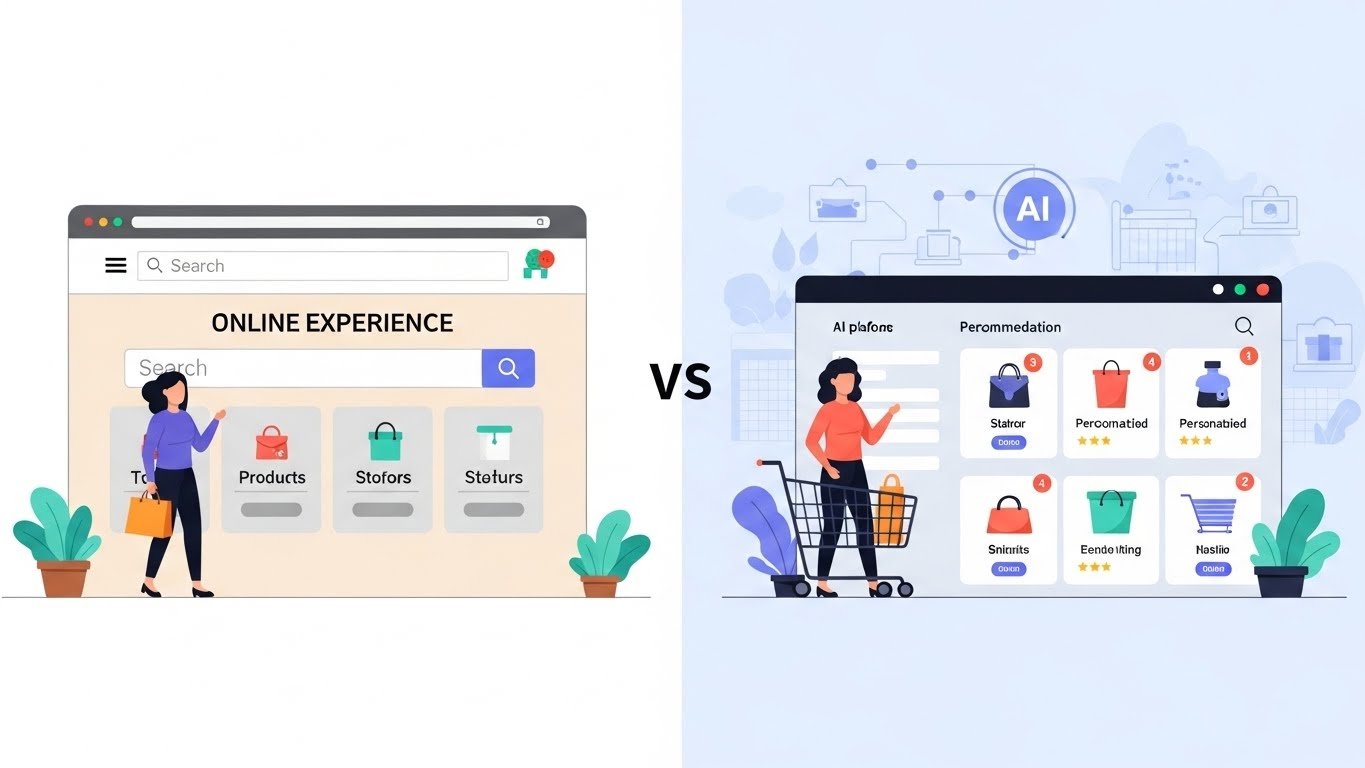
The first time I watched a customer navigate an online store equipped with intelligent recommendation technology, something clicked. She’d come looking for running shoes, but within three clicks, she’d also added moisture-wicking socks, a hydration belt, and a fitness tracker to her cart. Not because of aggressive upselling, but because the system genuinely understood what she might need. That experience fundamentally changed how I think about retail technology.
After spending over a decade working with e-commerce brands—from scrappy startups to established retailers—I’ve witnessed artificial intelligence evolve from a buzzword into something that genuinely transforms how people shop online. But here’s what many business owners get wrong: they treat AI as a magic wand rather than a strategic tool. Let me walk you through what actually works.
The Shift in Online Shopping Expectations
Remember when having a search bar and product categories felt revolutionary? Those days are long gone. Today’s consumers expect online stores to know them—not in a creepy way, but in the way a neighborhood shopkeeper might remember your preferences.
A study by Salesforce found that 66% of customers expect companies to understand their unique needs and expectations. That’s a tall order when you’re dealing with thousands or millions of shoppers. Human staff simply can’t scale to provide individualized attention to everyone who visits your digital storefront.
This is where artificial intelligence enters the picture, not as a replacement for human connection, but as an enabler of it at scale.
Personalization That Actually Feels Personal
Let’s be honest—most product recommendations feel generic. “Customers who bought this also bought that” barely scratches the surface of what’s possible now.
The most effective AI-powered personalization considers dozens of factors: browsing history, purchase patterns, time spent on specific product pages, seasonal preferences, price sensitivity, even the weather in your customer’s location. A coat retailer I consulted with saw their conversion rates jump 23% after implementing weather-based product suggestions. Showing parkas to customers in Minneapolis during a cold snap while featuring lighter jackets to shoppers in San Diego? Common sense, really, but impossible to execute manually at scale.
Beyond Product Recommendations
Smart personalization extends well beyond the “you might also like” carousel. Consider:
Homepage customization – First-time visitors see your bestsellers and brand story. Returning customers see new arrivals in their preferred categories and restocked items they previously viewed but didn’t purchase.
Email timing optimization – Some customers open emails at 7 AM during their commute. Others browse at 10 PM after the kids are asleep. AI systems learn these patterns and send communications when engagement is most likely.
Dynamic content blocks – The same webpage can display different images, copy, and calls-to-action based on user segments. A customer who typically buys during sales might see a countdown timer for the current promotion, while a full-price buyer sees new collection previews.
One mid-sized fashion retailer I worked with implemented these layered personalization strategies and reduced their customer acquisition costs by 31% within six months. The key wasn’t any single feature—it was the cumulative effect of making every touchpoint feel relevant.
Conversational Commerce: When Chatbots Actually Help
I’ll admit, I was skeptical about chatbots for years. Early implementations were frustrating—rigid decision trees that felt like navigating a phone menu. Ask anything unexpected, and you’d get “I don’t understand. Please rephrase your question” repeatedly until you gave up.
Modern conversational AI is different. Natural language processing has matured to the point where chatbots can understand context, remember previous parts of the conversation, and handle nuanced queries.
What Good Looks Like
The best chat implementations I’ve seen share common characteristics:
They know when to hand off to humans. This might seem counterintuitive, but acknowledging limitations builds trust. A chatbot that says “This question needs a real person—let me connect you with someone who can help” is infinitely better than one that gives confident but wrong answers.
They’re proactive without being intrusive. Rather than a popup the moment someone lands on the site, effective systems wait until behavioral signals suggest help might be useful—lingering on a size chart, repeatedly comparing two products, or starting to exit during checkout.
They remember across sessions. When a customer returns and the chat says “Hi Sarah, did those hiking boots you ordered last month work out well?” it feels like service, not surveillance. The difference often lies in how the interaction is framed.
Real Results
A home goods retailer I advised implemented an AI chat system focused specifically on product selection assistance. When customers asked “What’s the best vacuum for pet hair?” the system would ask follow-up questions about flooring type, home size, and budget before making recommendations.
The results surprised everyone: 41% of customers who engaged with the selection assistant made a purchase, compared to 12% for those who didn’t. Average order values were 28% higher too, likely because customers felt more confident in their choices.
Visual Search: Bridging the Imagination Gap
Here’s a scenario every online retailer knows: a customer sees a friend wearing something interesting, takes a quick photo, and wants to find something similar. In the old days, they’d try describing it—”blue floral dress with puffy sleeves”—and hope the search results were close.
Visual search technology lets customers upload images and find matching or similar products in your catalog. Pinterest has done this brilliantly, but the technology is increasingly accessible to smaller retailers.
This capability matters because it addresses a fundamental friction point. Customers don’t always have the vocabulary to describe what they want. A “mid-century modern coffee table with hairpin legs” might simply be “a table like this one I saw on Instagram” in their minds.
Implementation Considerations
Visual search works best with certain product categories—fashion, furniture, home décor, and anything where aesthetics drive purchase decisions. For commodity products or items selected primarily by specifications (electronics, for instance), traditional search usually serves customers better.
The technology also requires substantial catalog photography investment. The system can only match what it can “see,” so products need to be photographed from multiple angles in consistent lighting. For retailers already investing in strong product imagery, adding visual search is relatively straightforward. For those with limited photography, this prerequisite investment can be significant.
Intelligent Customer Support Ticket Routing
Behind the scenes, AI transforms support operations in ways customers never directly see but absolutely feel.
Consider the difference between waiting three days for a response versus three hours. Between being transferred twice because your question went to the wrong department versus getting the right specialist immediately. These experiences shape how customers perceive your brand.
Modern ticket routing systems analyze incoming support requests and:
- Categorize issues by type and urgency
- Route to agents with relevant expertise and current capacity
- Suggest potential solutions based on similar past tickets
- Flag VIP customers or those showing signs of churn for priority handling
One electronics retailer reduced their average resolution time by 47% after implementing intelligent routing. More impressively, customer satisfaction scores improved even though they hadn’t added any support staff. People simply got faster, more relevant help.
Inventory Intelligence and Availability
Nothing frustrates online shoppers more than finding the perfect product, adding it to cart, and discovering it’s out of stock in their size or color. AI-powered inventory management helps prevent these disappointments in several ways.
Predictive stock management analyzes sales patterns, seasonal trends, marketing calendars, and external factors (like competitor promotions or broader economic indicators) to forecast demand more accurately. This means popular items are less likely to run out unexpectedly.
Smart product displays can prioritize items with healthy inventory levels while de-emphasizing products running low. This subtle curation improves the customer experience while reducing the operational headache of explaining why something they wanted isn’t available.
Backorder and restock notifications become more intelligent too. Rather than simply offering to email when something returns, AI systems can estimate likely restock dates and even suggest similar alternatives that are immediately available.
A sporting goods company I consulted saw their stockout-related customer complaints drop by 62% after implementing predictive inventory management. They didn’t carry more inventory—they carried smarter inventory.
Dynamic Pricing Done Right
Let me address the elephant in the room: dynamic pricing makes people uncomfortable. The perception that prices change based on how badly you want something feels manipulative.
But there’s a version of this that genuinely benefits customers. Consider:
Demand-based pricing that goes both ways. Yes, concert tickets get more expensive as the event approaches and seats fill. But airline prices also drop when flights aren’t selling well. Dynamic pricing can mean discounts on slow-moving inventory, benefiting bargain hunters.
Personalized promotional pricing. Rather than blanket sales that train customers to wait for discounts, AI can identify which customers need price incentives to purchase and which don’t. A first-time visitor might see a welcome discount, while a loyal repeat customer might see early access to new products instead.
Competitive price matching. Automated monitoring of competitor prices allows retailers to adjust in real-time, ensuring customers don’t feel like they’re overpaying.
The key is transparency. Retailers who are upfront about their pricing logic—”Price varies based on demand and availability”—fare much better than those who seem to hide it.
Fraud Prevention Without Friction
Here’s a tension point many retailers struggle with: rigorous fraud prevention often creates friction for legitimate customers. Strict verification requirements mean honest shoppers face hoops to jump through.
AI-based fraud detection analyzes patterns that would be invisible to human reviewers. Machine learning models can consider hundreds of variables simultaneously: device fingerprints, typing patterns, purchase history, geolocation consistency, time-of-day patterns, and countless other signals.
This sophistication means fewer false positives—legitimate purchases incorrectly flagged as potentially fraudulent. One payment processor I spoke with reported that upgrading to AI-driven fraud detection reduced false declines by 35% while actually improving fraud catch rates.
For customers, this means smoother checkouts. No sudden “verify your identity” interruptions when you’re simply buying something while traveling. No declined transactions that require calling your bank. The security is stronger, but the experience is frictionless.
Voice Commerce: The Emerging Frontier
I’ll be candid—voice commerce hasn’t hit mainstream adoption the way many predicted five years ago. But it’s growing, particularly for certain purchase types.
Reordering consumables works well by voice. “Order more dog food” when you notice the bag is nearly empty is convenient and natural. Similarly, adding items to a shared household shopping list or checking order status doesn’t require visual product browsing.
Smart retailers are building voice capabilities for these high-frequency, low-consideration purchases while maintaining visual experiences for discovery and complex decisions.
The customer experience improvement comes from meeting people where they are. Sometimes that’s at a computer. Sometimes it’s on a phone. And increasingly, sometimes it’s calling out to a smart speaker while cooking dinner.
Predictive Customer Service
Perhaps the most sophisticated AI application in customer experience is predicting problems before they occur—and proactively addressing them.
This looks like:
Shipping exception alerts – When carrier data suggests a package might be delayed, reaching out to the customer before they start wondering where their order is. “We noticed your shipment from [carrier] may arrive a day late. We’re monitoring it closely and will update you immediately if there’s any change.”
Churn prediction – Identifying customers showing early warning signs of disengagement and triggering retention campaigns before they’ve fully lapsed.
Product satisfaction scoring – Analyzing review sentiment and return patterns to identify products that might disappoint certain customer segments, then adjusting recommendations accordingly.
A subscription box company I advised implemented churn prediction and saved an estimated $1.2 million annually by intervening with at-risk subscribers before they canceled. The interventions weren’t dramatic—often just a personalized email from the founder asking if everything was okay. But timing those messages precisely made all the difference.
The Limitations We Need to Acknowledge
I’d be doing you a disservice if I painted an exclusively rosy picture. AI in e-commerce has real constraints.
Data requirements are substantial. These systems need significant data to work effectively. A store doing 50 orders monthly won’t have enough signal for meaningful personalization. Many AI tools require thousands of data points before patterns become actionable.
Implementation isn’t plug-and-play. Despite vendor promises, integrating AI capabilities with existing platforms often requires significant technical work. Data needs to be clean, formatted correctly, and flowing between systems reliably. This takes time and expertise.
Ongoing refinement is essential. AI models aren’t set-and-forget. They need monitoring, adjustment, and periodic retraining. Customer behaviors change, product catalogs evolve, and systems can drift toward suboptimal recommendations without oversight.
Not every application delivers ROI. I’ve seen companies implement AI features because they seemed innovative, not because they solved actual customer problems. A sophisticated size recommendation engine doesn’t help much if your sizing is already consistent and easy to understand.
The most successful implementations I’ve witnessed came from businesses that started with specific customer experience pain points and worked backward to whether AI could address them—not the reverse.
Ethical Considerations That Matter
As someone who cares about how technology affects people, I think retailers need to grapple seriously with the ethical dimensions of AI in commerce.
Transparency – Customers deserve to know when they’re interacting with automated systems. Chatbots should identify themselves as such. Personalization should be visible and adjustable.
Privacy – The data that enables personalization also raises privacy concerns. Collecting browsing behavior, purchase history, and interaction patterns comes with responsibility. Clear data policies, secure storage, and customer control over their information aren’t optional.
Manipulation concerns – There’s a line between helpful personalization and exploitative manipulation. Using AI to identify customers’ vulnerabilities and exploit them—triggering impulse purchases, creating artificial urgency, or preying on emotional states—crosses an ethical boundary, even if it boosts short-term sales.
Accessibility – AI-powered interfaces must remain accessible to users with disabilities. A voice commerce system that doesn’t work with screen readers or a visual search that has no text alternative fails significant customer segments.
The retailers I most respect use AI to genuinely serve customers better—not to extract more from them.
Looking Ahead
The technology continues advancing. I expect we’ll see AI becoming less visible and more embedded—not as a feature you notice but as an invisible layer that makes everything work better.
Hyper-personalization will mature. Instead of segments like “women 25-34 interested in fitness,” systems will increasingly treat each customer as a segment of one, with truly individualized experiences.
Predictive capabilities will grow. We’ll move from “recommending based on what you’ve done” to “anticipating what you’ll need next”—your winter coat wearing out at about the same time everyone else’s does, triggering a personalized fall outerwear campaign.
Conversational interfaces will become truly conversational. Shopping through natural dialogue, with systems that remember context across weeks or months, will feel normal.
But the fundamental principle won’t change: technology exists to serve human needs. The retailers who succeed with AI will be those who never forget that the goal is better customer experiences, not fancier technology.
Practical Steps Forward
If you’re running an online store and considering AI investments, here’s where I’d suggest starting:
- Audit your current customer experience pain points. Where do people drop off? What do support tickets consistently complain about? What questions come up repeatedly? Let these pain points guide your priorities.
- Start with high-impact, lower-complexity implementations. Product recommendations and basic chatbots have mature solutions and proven ROI. Get wins under your belt before tackling more ambitious projects.
- Ensure your data foundation is solid. AI is only as good as the data feeding it. Invest in data quality, integration between systems, and proper customer identity management before layering on sophisticated AI.
- Plan for ongoing optimization. Budget not just for implementation but for the continuous refinement these systems require. Factor in the human oversight needed to keep AI aligned with your customer experience goals.
- Keep customers in the loop. Be transparent about how you’re using technology and data. Give customers control where possible. Build trust rather than eroding it.
The opportunity here is real. Done thoughtfully, AI genuinely makes online shopping better—more relevant, more convenient, more satisfying. But it requires treating the technology as a means to an end, not an end in itself.
After all these years in e-commerce, that’s the lesson that keeps proving itself true: the best technology is the kind customers never have to think about because it simply makes their experience better. AI has that potential, and we’re really just getting started.