
I’ll be honest—when AI writing tools first started gaining traction around 2021, I was deeply skeptical. After spending fifteen years in content marketing and SEO, I’d developed strong opinions about what made content rank and convert. The idea that software could replicate the nuance of understanding search intent, weaving in keywords naturally, and creating content that genuinely helped readers seemed far-fetched at best.
Then a client handed me a blog post their marketing coordinator had created using one of these tools. I assumed I’d find the usual signs of automated content—awkward phrasing, keyword stuffing, generic filler that said nothing. Instead, I found a solid first draft that, with some editing, became one of their best-performing pieces that quarter.
That experience forced me to reconsider my assumptions. Not because AI had suddenly become capable of replacing skilled content creators—it hadn’t, and still hasn’t—but because these tools had become genuinely useful for parts of the content creation process that previously consumed enormous time without adding proportional value.
Three years later, AI tools are woven into my content workflow and the workflows of most SEO professionals I know. But the gap between using these tools effectively and using them poorly is substantial. I’ve watched agencies produce embarrassing content by over-relying on AI, and I’ve seen lean content teams punch far above their weight by integrating these tools thoughtfully.
This article is my attempt to share what I’ve learned about which AI tools actually help with SEO content, how to use them without sacrificing quality, and where they still fall short.
The Fundamental Shift in SEO Content Creation
To understand where AI tools fit, you need to understand how SEO content creation has evolved—and why traditional approaches are struggling.
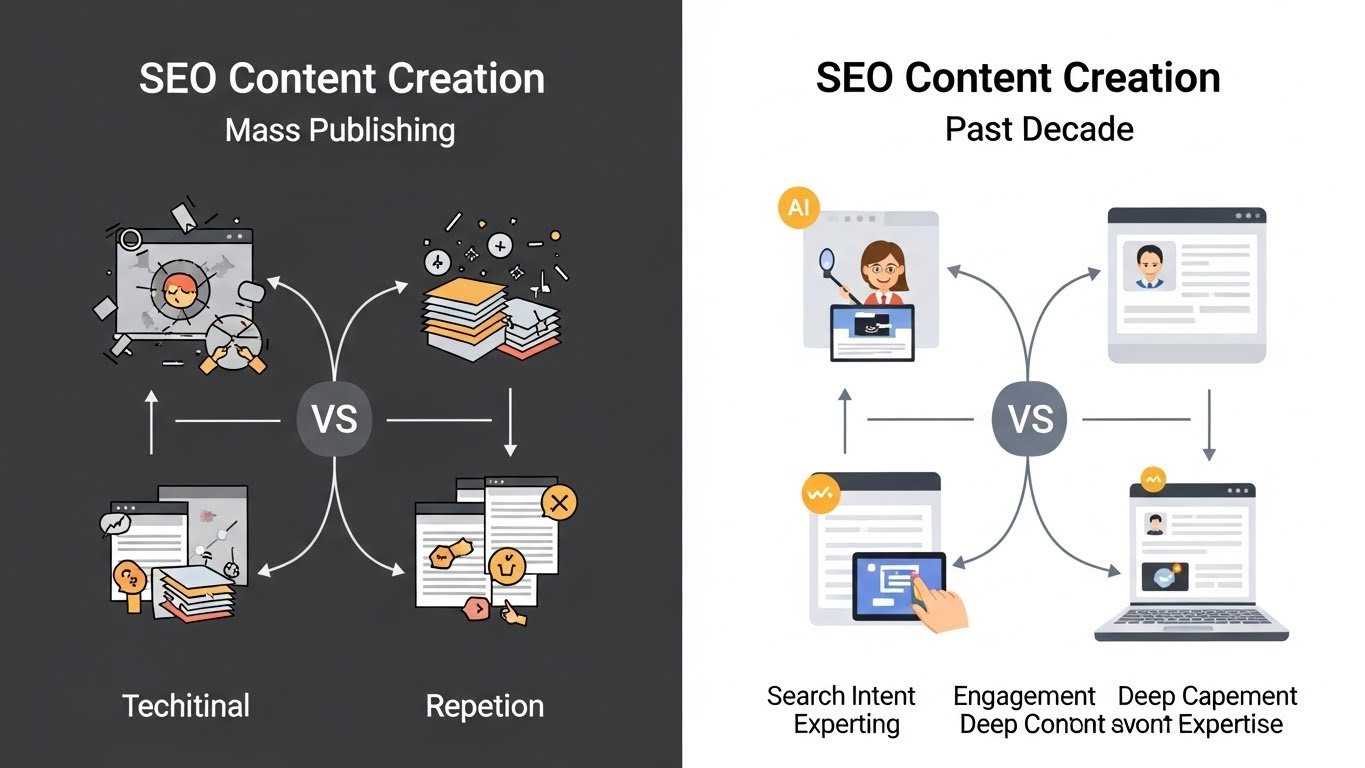
A decade ago, SEO content was largely a volume game. Publish frequently, target keywords directly, build links, repeat. Content quality mattered, but you could get away with mediocre writing if your keyword targeting and link building were strong.
Google’s algorithms have changed that calculus dramatically. The helpful content updates, experience signals in E-E-A-T, passage indexing, and increasingly sophisticated understanding of search intent mean that thin content struggles regardless of technical optimization. At the same time, competition has intensified. Topics that once had a handful of articles now have thousands.
Creating content that ranks today requires:
- Deep understanding of search intent
- Comprehensive coverage of topics
- Genuine expertise or experience
- Technical SEO fundamentals
- Strong engagement signals
- Consistent publishing schedules
That’s a lot to execute, especially for smaller teams. AI tools don’t solve all these challenges, but they address some of the most time-consuming bottlenecks—particularly research, first-draft creation, and optimization.
What AI SEO Tools Actually Do
Before evaluating specific tools, let’s establish what capabilities we’re actually discussing. AI tools for SEO content fall into several categories, and understanding these categories helps you choose the right tools for your needs.
Content Generation Tools
These tools produce actual text—blog posts, product descriptions, meta tags, social content. They range from general-purpose writing assistants to specialized SEO content generators. Some can produce complete articles from a brief; others work best for specific content elements.
What they do well: First drafts, outlines, meta descriptions, product descriptions, content variations, overcoming blank page paralysis.
Where they struggle: Original insights, personal experience, complex arguments, brand voice consistency, factual accuracy.
SEO Analysis and Optimization Tools
These tools analyze your content against ranking competitors and provide optimization recommendations. They examine keyword usage, content structure, topic coverage, readability, and other factors that correlate with ranking performance.
What they do well: Identifying missing topics, keyword distribution analysis, competitive gap analysis, structural recommendations.
Where they struggle: Understanding intent nuances, weighing conflicting signals, accounting for brand context, predicting ranking outcomes.
Research and Briefing Tools
These tools help you understand what content should cover before you write it. They analyze search results, identify questions people ask, map topic clusters, and compile competitive intelligence.
What they do well: Topic research, question identification, outline generation, competitive analysis, content gap identification.
Where they struggle: Determining genuine user needs versus surface-level patterns, identifying unique angles, assessing source credibility.
Hybrid Platforms
Many current tools combine multiple capabilities—research, writing, and optimization in integrated workflows. These platforms aim to streamline the entire content creation process.
The most effective content teams typically use multiple specialized tools rather than relying on a single platform for everything. Each tool has strengths; combining them strategically produces better results than any single solution.
The Tools That Actually Deliver Results
After extensive testing across dozens of projects, here are the AI tools that have earned a place in my regular workflow and the workflows of content professionals I respect.
Surfer SEO: The Optimization Standard
If I could only use one AI tool for SEO content, it would probably be Surfer SEO. Not because it’s the best writer—it’s not primarily a writing tool—but because it provides the clearest guidance on what optimized content should include.
Surfer analyzes the top-ranking pages for your target keyword and provides specific recommendations: word count ranges, keyword density, heading structure, related terms to include, and questions to answer. The content editor shows a real-time score as you write, guiding optimization without requiring you to manually analyze competitors.
What sets Surfer apart is the specificity. Rather than generic advice like “include more keywords,” you get guidance like “mention ‘content marketing strategy’ 4-6 times” and “include sections on ‘content calendar’ and ‘content distribution.'” This granularity makes optimization actionable rather than abstract.
I’ve used Surfer on hundreds of articles and consistently see correlation between Surfer scores and ranking performance. Not perfect correlation—nothing in SEO is that clean—but strong enough to validate the approach.
Strengths:
- Specific, actionable optimization recommendations
- Real-time content scoring
- Competitive analysis based on actual SERP data
- Integrations with Google Docs and WordPress
- Content audit capabilities for existing pages
Limitations:
- Recommendations based on correlation, not causation
- Can encourage over-optimization if followed blindly
- Less useful for topics with limited search data
- Doesn’t account for brand authority or existing rankings
Best for: Optimizing content during and after writing, identifying content gaps, competitive analysis.
Pricing: Plans start around $89/month, with higher tiers for agencies and enterprise.
Clearscope: Enterprise-Grade Content Optimization
Clearscope occupies similar territory to Surfer but positions itself more explicitly for enterprise content teams. The interface is cleaner, the recommendations are presented differently, and the focus is squarely on content quality rather than trying to be a full SEO suite.
What I appreciate about Clearscope is its simplicity. You enter a keyword, it provides a content grade and recommendations, you write and optimize until your grade is strong. There’s less feature bloat than some competitors, which makes it easier to train team members and integrate into existing workflows.
The grading system (A++ through F) provides intuitive feedback that non-SEO team members understand. Writers can self-assess their optimization without needing extensive SEO training, which is valuable for teams where content creators aren’t SEO specialists.
Several large publishers I’ve worked with use Clearscope as their standard—they won’t publish content that doesn’t achieve at least an A grade. Whether that’s optimal is debatable (more on that later), but it demonstrates how the tool functions as workflow infrastructure.
Strengths:
- Clean, focused interface
- Easy to train team members
- Strong enterprise features
- Reliable recommendations
- Excellent customer support
Limitations:
- Higher price point than alternatives
- Fewer features than all-in-one platforms
- Can feel limiting for advanced users
- Limited content generation capabilities
Best for: Enterprise teams, publications with many writers, organizations prioritizing consistency.
Pricing: Starts around $170/month, with enterprise pricing for larger teams.
Frase: Research-First Content Creation
Frase takes a different approach, emphasizing research and briefing before content creation. The platform analyzes search results to understand what content covers, then helps you create comprehensive briefs before writing begins.
For content strategists who develop briefs for other writers—whether in-house or freelance—Frase is particularly valuable. You can quickly analyze what top-ranking content includes, identify questions searchers ask, and compile structured briefs that guide writing toward comprehensive coverage.
The AI writing features are capable but not the platform’s primary strength. Where Frase excels is helping you understand what content should include before you create it. That research phase is often undervalued in content workflows, and Frase makes it more efficient.
I’ve found Frase particularly useful for complex B2B topics where understanding the information landscape is essential before writing. For simpler consumer content, the depth might be overkill.
Strengths:
- Excellent research and briefing capabilities
- Question identification from search data
- SERP analysis and competitive intelligence
- Reasonable pricing for capabilities offered
- Good balance of research and writing features
Limitations:
- Writing capabilities less polished than dedicated tools
- Interface can feel cluttered
- Learning curve for full feature utilization
- Occasional performance issues with complex queries
Best for: Content strategists, research-heavy content, comprehensive briefing workflows.
Pricing: Plans start around $15/month for basic features, with full capabilities around $115/month.
Jasper: The General-Purpose Writing Workhorse
Jasper (formerly Jarvis) remains the most recognized AI writing tool in the marketing world. Its brand presence is strong, the platform is polished, and the writing output is generally solid.
For pure content generation—producing drafts, variations, short-form content—Jasper is reliable. The template library covers most common marketing content types, and the long-form assistant handles blog posts reasonably well with appropriate guidance.
Where I’ve seen Jasper work best is for teams producing high volumes of relatively standardized content. Product descriptions, social media posts, email variations, ad copy—content types where good-enough at scale matters more than exceptional quality for individual pieces.
For SEO blog content specifically, I typically use Jasper for initial drafts or sections, then bring that content into Surfer or Clearscope for optimization. Jasper doesn’t provide the competitive analysis and optimization guidance that dedicated SEO tools offer.
Strengths:
- Polished, user-friendly interface
- Extensive template library
- Reliable output quality
- Strong brand voice training capabilities
- Active development and feature updates
Limitations:
- Limited SEO-specific guidance
- Requires editing for quality standards
- Can produce generic content without careful prompting
- Higher pricing than some alternatives
- Output can feel formulaic without customization
Best for: Volume content production, short-form marketing content, teams with strong editing capabilities.
Pricing: Starts around $49/month for individuals, with team and enterprise plans at higher tiers.
MarketMuse: The Strategic Planning Platform
MarketMuse operates at a different level than most AI content tools. Rather than focusing on individual articles, it emphasizes content strategy—identifying topic clusters, prioritizing content opportunities, and planning comprehensive coverage.
The platform’s strength is helping you understand where content gaps exist in your overall strategy. What topics should you cover? What existing content needs improvement? How should topics relate to each other in clusters? MarketMuse provides data-driven answers to these strategic questions.
For individual article optimization, MarketMuse offers capabilities similar to Surfer and Clearscope. But the real value is in strategic planning for sites with substantial content programs.
I’ve used MarketMuse primarily for content audits and strategic planning rather than day-to-day writing. When a client has hundreds of existing pages and needs to understand what’s working, what needs updating, and where opportunities exist, MarketMuse provides insights that would take weeks to compile manually.
Strengths:
- Strategic content planning capabilities
- Topic modeling and cluster identification
- Content inventory and audit features
- Personalized difficulty scoring based on your domain
- Competitive content gap analysis
Limitations:
- High price point limits accessibility
- Complexity requires learning investment
- Less suited for individual article creation
- Can overwhelm smaller teams
Best for: Large content programs, strategic planning, content audits, enterprise teams.
Pricing: Expensive—plans start around $600/month, with enterprise pricing significantly higher.
NeuronWriter: The Value Leader
NeuronWriter deserves mention as a strong value option that combines content optimization with AI writing capabilities. The platform is less polished than leaders like Surfer or Clearscope, but it delivers solid functionality at a fraction of the cost.
For freelancers, small agencies, and individual content creators, NeuronWriter offers capable optimization guidance without the investment required for enterprise tools. The AI writing features are adequate for draft generation, and the competitive analysis helps guide optimization.
I’ve recommended NeuronWriter to several smaller clients who needed optimization capabilities but couldn’t justify enterprise pricing. The results have been positive—not as comprehensive as premium tools, but effective for teams working with limited budgets.
Strengths:
- Aggressive pricing for capabilities offered
- Solid optimization recommendations
- AI writing features included
- Regular feature updates
- Good value for small teams
Limitations:
- Less refined interface than premium competitors
- Smaller user community and fewer resources
- Occasional accuracy issues with recommendations
- Limited integrations
Best for: Budget-conscious teams, freelancers, small agencies, individual creators.
Pricing: Plans start around $19/month, with higher tiers for more content and features.
Copy.ai: Versatile Content Generation
Copy.ai has evolved from a simple copywriting tool into a more comprehensive platform with workflow automation and various content types. For marketing teams needing versatile content generation, it’s worth considering.
The platform excels at shorter content forms—headlines, email subject lines, ad copy, social posts. Blog content generation is capable but requires more guidance and editing than specialized tools.
What’s interesting about Copy.ai’s recent development is the workflow focus. Rather than just generating content, you can build automated workflows that incorporate AI generation into larger processes. For teams managing complex content operations, this workflow approach has potential.
Strengths:
- Versatile content type support
- Workflow automation capabilities
- Strong short-form content quality
- Regular updates and improvements
- Reasonable pricing for features
Limitations:
- Long-form content requires more refinement
- SEO guidance is limited compared to dedicated tools
- Can produce inconsistent results across use cases
- Workflow features have learning curve
Best for: Marketing teams needing versatile content types, short-form content, workflow automation.
Pricing: Free tier available, with pro plans starting around $49/month.
Semrush Writing Assistant: Integrated Suite Advantage
If you’re already using Semrush for SEO—and many content teams are—the Writing Assistant integrates content optimization into a platform you’re likely already paying for.
The Writing Assistant provides real-time recommendations for readability, SEO, originality, and tone of voice. It’s less specialized than dedicated optimization tools like Surfer or Clearscope, but the integration with Semrush’s broader SEO data is valuable.
I use the Writing Assistant primarily for quick optimization checks within Google Docs, where it integrates seamlessly. For serious optimization work, I still turn to dedicated tools, but for routine content that needs basic SEO guidance, it’s convenient.
Strengths:
- Integration with Semrush ecosystem
- Readability and originality scoring
- Google Docs integration
- Included in Semrush subscriptions
- Brand voice consistency checking
Limitations:
- Less sophisticated than dedicated optimization tools
- Recommendations can be generic
- Requires Semrush subscription
- Limited competitive analysis depth
Best for: Teams already using Semrush, routine content optimization, quick checks.
Pricing: Included with Semrush subscriptions (starting around $130/month for the platform).
How to Actually Use These Tools Effectively
Having the right tools matters less than using them correctly. After watching many content teams struggle with AI integration, I’ve identified patterns that separate effective implementation from disappointing results.
Use AI for First Drafts, Not Final Products
This might be the most important principle: AI-generated content should be the starting point, not the destination. Every piece of AI-generated content needs human editing, fact-checking, and enhancement.
I think of AI writing tools as producing “draft zero”—the raw material that precedes even a first draft. The AI gets words on the page and provides a structure to work with. From there, human writers add original insights, verify accuracy, improve flow, strengthen arguments, and ensure the content actually delivers value.
Teams that publish AI content with minimal editing consistently produce mediocre results. The content ranks initially—if optimized properly—but fails to engage, doesn’t earn links, and eventually loses ground to better content.
Combine Tools Strategically
No single tool excels at everything. The most effective workflows combine tools based on their strengths:
- Research phase: Use Frase or MarketMuse to understand what content should cover
- Briefing: Create structured outlines incorporating research insights
- Drafting: Use Jasper, Copy.ai, or similar tools to generate initial content
- Optimization: Run content through Surfer or Clearscope for SEO refinement
- Editing: Human editing for quality, accuracy, voice, and unique value
- Publishing: Final checks and publication
This workflow takes longer than simply generating content with a single tool, but the output quality is substantially higher.
Don’t Chase Perfect Optimization Scores
Here’s something that took me a while to learn: perfect optimization scores don’t equal perfect content. Tools like Surfer and Clearscope provide valuable guidance, but following recommendations blindly can create awkward, over-optimized content that reads poorly.
The optimization score should inform your decisions, not dictate them. If Surfer suggests including a term that doesn’t fit naturally, don’t force it. If Clearscope wants more mentions of a phrase but it would sound repetitive, use your judgment.
I generally aim for scores in the strong-but-not-perfect range. For Surfer, that’s typically 75-90. For Clearscope, A or A+ without obsessing over A++. The marginal effort to achieve perfect scores rarely produces proportional ranking benefits.
Maintain Your Voice and Expertise
AI tools don’t know your brand, your audience, or your unique expertise. They produce generic content that could have come from anyone. Your job is to infuse AI-assisted content with what makes your perspective valuable.
This means adding:
- Original insights from your experience
- Specific examples and case studies
- Opinions and perspectives that differentiate your content
- Nuances that generic content misses
- Brand voice and personality
Content that sounds like everyone else won’t stand out regardless of how well it’s optimized. AI should accelerate your content creation, not flatten it into sameness.
Fact-Check Everything
AI writing tools confidently produce inaccurate information. Statistics get invented. Dates get wrong. Attributions get confused. Technical details get garbled. This isn’t occasional—it’s frequent.
Every claim in AI-generated content needs verification. Every statistic needs a source. Every technical detail needs expert review. If you can’t verify it, don’t publish it.
I’ve seen AI tools invent studies that don’t exist, attribute quotes to people who never said them, and describe features products don’t have. Publishing inaccurate content damages credibility and can create legal exposure. The time saved in writing gets negated—and then some—if you have to correct published misinformation.
Use Optimization Tools for Updates, Not Just New Content
Some of the highest-ROI applications of optimization tools involve updating existing content rather than creating new pieces. Take content that’s ranking on page two or three, run it through optimization analysis, identify gaps, and improve it.
This approach often produces faster ranking improvements than new content creation. Google already recognizes your page as relevant; comprehensive improvements can push it higher.
I regularly audit client content using optimization tools, identifying pages with ranking potential that could improve with better optimization. These updates often require less effort than new content while delivering comparable results.
Where AI Tools Still Fall Short
Honest assessment requires acknowledging limitations. These tools have improved dramatically, but significant gaps remain.
Original Thought and True Expertise
AI tools can synthesize existing information effectively, but they can’t generate genuine original insights. They haven’t lived experience, conducted research, or developed expertise through years of practice.
For content that requires true expertise—detailed how-to guides from practitioners, analysis that requires domain knowledge, thought leadership that advances conversations—AI tools provide limited value beyond efficiency gains. The substance must come from human experts.
This is particularly relevant given Google’s emphasis on E-E-A-T (Experience, Expertise, Authoritativeness, Trust). Content demonstrating real experience and expertise ranks better and deserves to. AI-generated content struggles to demonstrate experience the writer never had.
Understanding True Search Intent
AI optimization tools analyze what ranking content includes, but that’s not the same as understanding why people search. Sometimes searchers want something different from what current results provide. Sometimes the top results don’t actually satisfy user needs. Sometimes intent is shifting as topics evolve.
AI tools optimize toward existing patterns. Human insight is needed to recognize when those patterns should be challenged—when doing something different might serve users better than following the established playbook.
Brand Voice and Emotional Resonance
AI writing tends toward generic competence—clear, grammatically correct, but bland. Creating content that genuinely sounds like your brand, connects emotionally with readers, or expresses distinct personality requires human attention.
Teams can train AI tools on brand voice to some degree, and results improve with careful guidance. But achieving the authenticity that builds genuine audience connection remains difficult through AI alone.
Accuracy and Reliability
I’ve emphasized this before, but it bears repeating: AI tools make things up. Factual accuracy is not a strength. For content where accuracy matters—which is most content worth publishing—human verification is essential.
Ethical and Sensitive Topics
AI tools don’t understand ethical nuance. They’ll produce content on sensitive topics without appropriate care, make claims that could harm readers, or fail to recognize when topics require expert guidance. Human judgment is essential for content that could affect reader decisions on health, finances, legal matters, or other consequential topics.
The Ethical Considerations That Matter
The rise of AI content tools raises legitimate questions that responsible content creators should consider.
Disclosure and Transparency
Should you disclose when content is AI-assisted? There’s no legal requirement in most contexts, but ethical considerations exist. Readers might assume content represents the author’s original work and thinking. Using AI for substantial portions of content creation without any acknowledgment could be seen as misleading.
My own approach: I don’t disclose AI assistance for routine content where the final product reflects my expertise and judgment—where AI served as a tool like any other. For content substantially generated by AI with minimal original contribution, I’d be more inclined to disclose, though honestly, I don’t publish such content because it rarely meets quality standards.
Different contexts warrant different approaches. Journalism has different standards than marketing content. Academic work differs from business communications. Consider what your audience reasonably expects.
Content Quality and Reader Value
The ease of AI content generation creates temptation to prioritize volume over quality. Why spend hours crafting excellent content when you can produce adequate content in minutes?
But adequate content doesn’t serve readers well, doesn’t build audience loyalty, and increasingly doesn’t rank well as Google gets better at identifying helpful content. The ethical approach—which is also the strategic approach—is using AI to make quality content more efficient, not using it to flood the internet with more mediocrity.
Employment and Industry Impact
AI tools genuinely affect content industry employment. They haven’t eliminated jobs yet, but they’ve changed what skills matter and how work is structured. Junior writing roles that focused on basic content production are most vulnerable.
Responsible adoption means considering impact on teams and individuals. How can AI tools augment human capabilities rather than simply reducing headcount? How can affected workers develop skills that remain valuable? These questions don’t have easy answers, but ignoring them isn’t ethical.
Environmental Considerations
AI processing consumes substantial computing resources with associated environmental impact. Training large language models requires enormous energy; every AI-generated sentence has a carbon footprint.
This doesn’t mean avoiding AI tools—their efficiency gains may offset environmental costs in some contexts. But awareness of these costs should inform decisions about when AI assistance adds sufficient value to justify resource consumption.
Looking Ahead: Where This Is Going
Predicting AI development is notoriously difficult, but some trends seem likely to continue affecting SEO content creation.
Deeper Integration
Expect AI capabilities to become more deeply integrated into standard content tools rather than requiring separate specialized platforms. Google Docs, WordPress, and other mainstream tools already incorporate AI features, and this integration will accelerate.
Better Optimization Guidance
As search engines become more sophisticated, optimization tools will need to evolve beyond current keyword-focused approaches. Expect more emphasis on semantic relevance, topic expertise signals, and user engagement predictions.
Detection and Response
Search engines are actively developing capabilities to identify AI-generated content. While the goal isn’t necessarily to penalize AI content, low-quality AI content will likely face increasing scrutiny. The bar for content quality—AI-assisted or not—will continue rising.
Specialization
General-purpose AI writing tools may give ground to specialized tools for specific industries, content types, or use cases. A tool optimized for SaaS content marketing might outperform a general tool for that specific application.
Human-AI Collaboration Evolution
The current phase—AI generates drafts, humans edit—will likely evolve toward more sophisticated collaboration patterns. AI might function more as a research partner and sounding board rather than just a draft generator.
Making This Work for Your Content Program
If you’re considering implementing AI tools for SEO content, here’s a practical framework based on what I’ve seen work.
Start with Clear Goals
What problems are you trying to solve? Common legitimate goals include:
- Increasing content production volume without proportional headcount growth
- Improving optimization consistency across content
- Reducing time spent on research and briefing
- Maintaining quality while meeting aggressive publishing schedules
Be specific about what success looks like before selecting tools.
Audit Your Current Process
Where are the bottlenecks in your existing content workflow? Where does time go that doesn’t add proportional value? AI tools should address actual inefficiencies, not create new processes for their own sake.
Start Small
Don’t overhaul your entire content operation overnight. Pilot AI tools on a subset of content, measure results, learn what works, then expand. The teams I’ve seen fail typically tried to transform everything immediately without building organizational capability.
Train Your Team
AI tools require skill to use effectively. Invest in training so team members understand how to get the best results, how to evaluate output quality, and how to avoid common pitfalls. A skilled operator with a modest tool outperforms an unskilled operator with a premium tool.
Measure What Matters
Track metrics that reflect actual content performance: organic traffic, rankings, engagement, conversions. Don’t confuse efficiency metrics (content produced per hour) with effectiveness metrics (content that achieves goals). More content doesn’t help if it doesn’t perform.
Iterate and Improve
Your first implementation won’t be optimal. Build feedback loops that help you learn what’s working and what isn’t. Adjust tool selection, workflow design, and quality standards based on actual results.
Final Thoughts
AI tools for SEO content have moved from novelty to necessity for competitive content programs. Used well, they genuinely improve efficiency and help create better-optimized content. Used poorly, they produce forgettable content that doesn’t serve readers or achieve business goals.
The key insight after three years of intensive use: AI tools are productivity multipliers, not quality replacements. They make skilled content professionals more productive. They don’t transform unskilled operators into skilled content creators.
If you have strong content fundamentals—clear strategy, genuine expertise, understanding of your audience, commitment to quality—AI tools can significantly accelerate your execution. If you lack those fundamentals, AI tools will just help you produce more mediocre content faster.
Invest in tools that match your needs and budget. But invest even more in the human judgment, expertise, and creativity that determine whether content actually succeeds. The tools will continue improving. The need for human value will only intensify.